

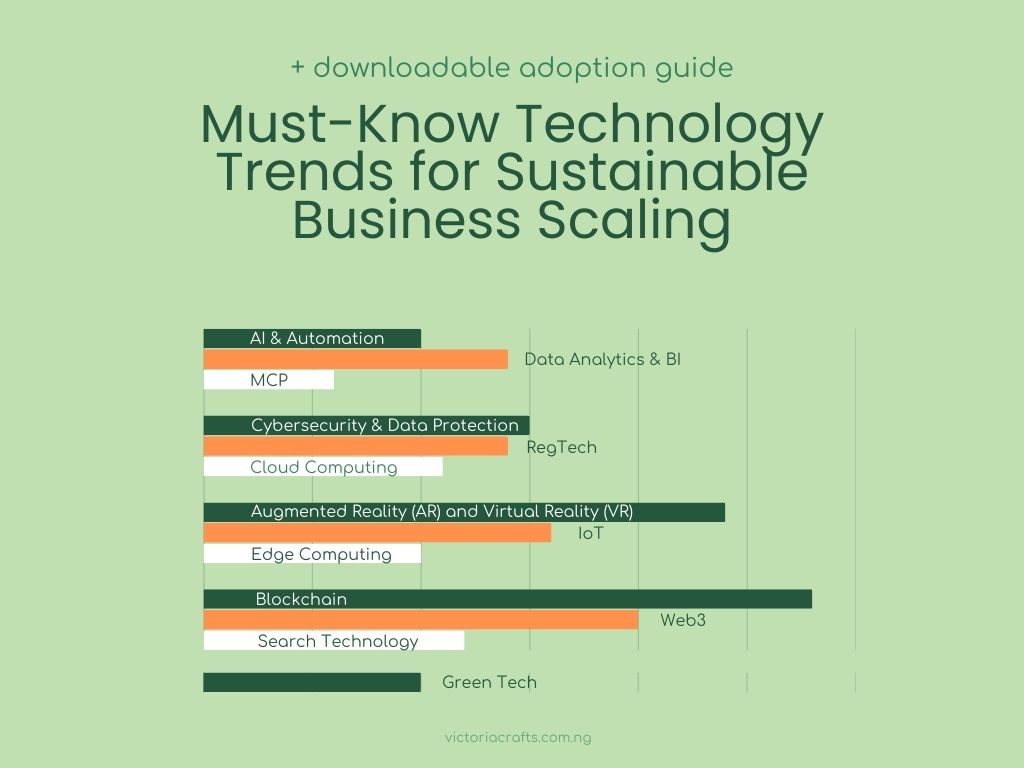
Technology trends are technological developments that gain widespread adoption because they solve real business problems. They influence how a business operates, competes, and grows. Therefore, if you want your business to remain relevant for a long time, you must understand the technologies and trends shaping the future.
However, adopting the latest tech trends without considering fundamental government compliance rules can expose businesses to legal, financial, and reputational risks. Therefore, sustainable growth through technology requires aligning tools with privacy standards, ethical practices, and regulatory expectations.
To make this achievable, VictoriaCrafts, an SEO service by Oludare Victoria Ibukun, created this in-depth guide (plus a free downloadable workbook) to help you confidently choose and adopt the right technology trends for your business.
Below are the most relevant technology trends shaping business growth this year.
1. #1 Leading Latest Tech Trend: Artificial Intelligence (AI) and Automation
Artificial Intelligence (AI) and automation are among the latest technological trends because they utilize computer languages and tools that enable businesses to work faster, make better decisions, and serve customers more efficiently without requiring constant human effort.
In real life, companies worldwide use these AI technologies to instantly answer customer questions and streamline transactions for a seamless customer experience.
In fact, a recent survey found that over 90% of Canadian companies are exploring or implementing AI for tasks such as customer interaction, order processing, and routine business operations.
These latest ICT trends help employers save time and reduce costs.
The marketing industry is also not behind. Some are using AI and automation, such as Agentic AI, to produce trending content.
However, when using these tools, you must at least follow basic compliance rules such as protecting people’s private information, being fair in how you use the technology, and having clear technology usage policies (standard operating procedures).
Ignoring these regulatory keeping tips can lead to fines, loss of trust, and harm to your company’s reputation.
2. Timeless Tech Trend for Business Growth: Cloud Computing
Cloud computing is one of the latest tech trends because it allows businesses to store files, run systems, and manage operations online, rather than relying solely on physical office computers. Simply put, it means your data and tools live on the internet and can be accessed securely from anywhere.
Tools like Google Drive, Microsoft 365, Zoom, Slack, Dropbox, QuickBooks Online, and cloud-based HR software are all real examples of this timeless tech trend in action.
A business in Lagos can store client contracts in the cloud and allow staff to access them from different locations. A company in Toronto can manage remote employees, run payroll, and track projects using cloud platforms without needing everyone in one office.
However, you must still be mindful of regulatory policies when using cloud services. This means selecting secure platforms, safeguarding employee and customer data, and adhering to the privacy rules applicable in various countries.
3. Cybersecurity and Data Protection Technologies
Cybersecurity is one of the most important technology trends because it focuses on protecting business systems, employee data, and customer information from online threats. Simply put, cybersecurity and data protection technologies help prevent hacking, data theft, and digital fraud.
Today, almost every business relies on digital tools such as email, cloud storage, online banking, and customer databases. This puts them at risk in the digital world, making cybersecurity a necessary tech trend.
That is why employers like you now use cybersecurity practices such as password managers, two-factor authentication (e.g., login codes sent to phones), antivirus software, encrypted file storage, and secure payment systems to protect their operations.
Even fintech companies in developing countries like Nigeria, such as Paystack and Flutterwave, invest heavily in cybersecurity to protect user transactions.
Hence, you are expected to comply with regulatory requirements by protecting customers’ and employees’ personal information. If you fail to take this seriously, you risk damaging your business growth and credibility.
4. Data Analytics and Business Intelligence
Data analytics and business intelligence are the latest tech trends that can help you understand what is happening inside your business and what customers are doing in real time. This tech trend works by collecting raw data and turning it into actionable insights that enable better decision-making.
Many businesses already use this tech trend without realising it. For example, most content writing business owners use Google Analytics to track website traffic, e-commerce dashboards to monitor sales, and CRM systems to understand customer behaviour.
Therefore, physical product brands, such as agricultural products, can use data analytics and business intelligence tools to identify which products sell faster. And service-based businesses can analyse client data to improve customer experience and increase retention.
But you must be careful. Ensure that customer and employee data is handled carefully, ethically collected, and not misused. When you obey compliance policies when applying data analytics, it becomes a strong foundation for growth, transparency, and long-term trust.
5. Re-emerging Technology Trends: Internet of Things (IoT)
The Internet of Things (IoT) is one of the emerging technology trends changing how businesses monitor operations and manage resources. It was coined by Kevin Ashton in 1999, with early incorporation by Coca-Cola’s vending machine.
This year, IoT has improved into AIoT (Artificial Intelligence of Things), where internet-connected devices make autonomous decisions. Precision farming in Agritech is a great example of today’s IoT.
Other examples of this IoT trend include smart CCTV cameras, GPS trackers in delivery vehicles, biometric attendance systems, smart meters, and inventory-tracking sensors. You can use IoT tools to track staff attendance, monitor equipment performance, manage energy usage, and oversee logistics in real time.
This trend in technology helps businesses reduce waste, improve productivity, and make better operational decisions. Nonetheless, users must use this IoT trend responsibly to avoid violating policies and gaining regulatory repercussions.
6. Blockchain Technology
Blockchain is one of the top technology trends for transparency and trust because it allows information to be stored in a way that is very hard to tamper with or falsify. In simple terms, blockchain is a shared digital ledger where every transaction is recorded and can be verified by anyone with permission.
You can experience this tech trend in action through cryptocurrencies. But businesses use blockchain for much more than that. For example, supply chain companies use it to track the origin of goods. Financial firms use it to record payments. And you can use blockchain to store contracts, verify supplier details, or securely record transactions.
Now, if you are part of those responsible employers (of course, you should aim for this), you will get the benefits of blockchain technology, which will help you stay compliant and credible as you grow.
7. Regulatory Technology (RegTech)
Regulatory Technology, often called RegTech, is one of the technology trends designed to help businesses comply with government regulations without drowning in paperwork. In simple terms, RegTech uses software to track laws, monitor activities, and produce reports so employers can stay on the right side of regulations while they grow.
Examples of how businesses can implement the Regtech trend include automating data documentation, tracking employee records, verifying customer identity, and flagging risky transactions. This technology transforms time-consuming missions into one-minute tasks.
Why does this matter? Well, the answer is that rules change fast, and mistakes are expensive.
RegTech gives you a clear dashboard of what’s happening, where risks live, and what needs attention. So that leaders can move quickly without stepping on legal landmines.
8. Augmented Reality (AR) and Virtual Reality (VR)
Augmented and Virtual Reality are among the most practical technology trends that are changing how people learn, train, and experience work. AR adds digital information to the real world (think of instructions appearing over a machine you’re fixing). VR places users inside a fully digital environment, like a realistic training simulator.
Just imagine it. A construction firm in busy urban cities like Lagos and Ontario can use VR to walk online clients through any building of their choice. This immersive technology cuts training costs, reduces mistakes, and speeds up learning.
However, you still need to comply with the relevant laws and regulations by ensuring user safety.
9. Edge Computing
Edge computing is one of the tech trends focused on accelerating data processing and improving security. Instead of sending all data to far‑away cloud servers, edge computing processes data closer to where it is created (i.e., on devices, local servers, or nearby networks.
In realistic terms, this tech trend powers smart security cameras that analyse footage instantly, banking apps that detect fraud in real time, and factory machines that respond immediately to performance issues. They give employers the ultimate control they desire.
You can obey compliance laws when using Edge computing tech by securing devices, controlling access, and ensuring ethical handling of data.
10. Green Technology
Green technology is one of the latest sustainable technology trends focused on helping businesses grow without damaging the environment. In simple terms, it refers to digital tools and innovations that reduce waste, save energy, and support long‑term sustainability while still improving performance.
For example, a company in Nigeria can reduce costs by switching to digital documentation instead of printing thousands of files. A business in Canada can use smart energy software to monitor electricity usage and cut down unnecessary consumption.
Its impact goes beyond image. This tech trend helps the planet improve efficiency and reduces operating costs in the workspace. Additionally, many governments and global partners now prefer to work with businesses that show commitment to sustainability.
But this doesn’t mean you should practice “greenwashing” (claiming to be eco‑friendly without real action). Because the offending companies attract legal trouble, serious penalties, and even closure.
11. Recent Trend in Technology: Model Context Protocol (MCP)
Model Context Protocol (MCP) is one of the new technology trends emerging from the rapid growth of artificial intelligence. In simple terms, MCP is a standard that helps AI systems such as chatbots, assistants, and enterprise tools connect safely and consistently to real business data, tools, and workflows.
Before MCP, companies used APIs (Application Programming Interfaces) to connect software systems, including AI tools.
The challenge was its complexity. Each system had its own API, every integration was built differently, and managing many connections became messy, fragile, and difficult to scale. As more tools were added, maintenance became stressful and costly.
MCP changes this by introducing a shared and structured way for AI to access tools and data. Instead of building custom connections for everything, organizations can use one standard approach that is easier to manage, safer to control, and more consistent across teams.
For example, your company can use MCP to connect its AI assistant to content calendars software, brand guidelines, CMS, analytics tools, project management boards, email systems, and approval workflows. This allows the AI to support the full content workflow, not just writing. With this shift, AI moves from being a simple writing tool to becoming a reliable operational assistant for effective content marketing.
Because MCP connects AI to sensitive business data, employers must meet regulatory and trust expectations. This includes strong access control, proper data protection, clear limits on what the AI can access, and ethical handling of both employee and customer information.
12. Web3
Web3 is one of the 10 technology trends shaping the future of the internet. Unlike the current web (where big platforms control most data), Web3 is built on the principle of decentralization. Meaning Web3 users and businesses have more control over their data, identity, and digital assets.
In simple terms, Web3 uses technologies such as blockchain, digital wallets, and smart contracts to enable people to interact online without relying entirely on central platforms like Google, Meta, or traditional banks.
You can experience Web3 technology by using decentralized finance (DeFi) platforms, NFTs, and decentralized identity tools that help verify users without collecting excessive personal data.
However, Web3 is still evolving, so you must be cautious, protect users, and avoid exposing customers to unnecessary regulatory breaches.
13. Search Technology
Search technology is one of the top 10 strategic technology trends. It determines who sees your brand, who trusts your expertise, and who chooses your business over competitors.
Today’s search tech trends go beyond traditional Google search. It includes AEO, GEO, AI search, Voice search, visual search, and personalized search results based on user behaviour. This is why today, employers who want consistent leads invest in strategic SEO content writing. An example is the approach Victoria Ibukun uses on VictoriaCrafts.
Additionally, to avoid legal repercussions for compliance offenses, it is important that you incorporate only ethical, best search optimization practices. This means you should avoid misleading headlines, false claims, and data manipulation.
Conclusion: How to Benefit from These Core Technology Trends
Technology trends will continue to shape how businesses operate, compete, and grow across industries. However, long‑term success does not come from adopting every new tool that appears. It comes from understanding which technology trends align with your business goals, operational capacity, and growth stage.
Afterall, employers that leverage technology strategically gain more than efficiency. They build resilience, make great decisions, protect trust, and position themselves as forward‑thinking leaders in their industry. From artificial intelligence and data analytics to search technology, Web3, and emerging new frameworks like MCP, the real benefit lies in intentional adoption, not trend‑chasing.
To help you move from trend‑watching and into intentional, strategic technology adoption, this article is supported by a free practical resource designed for your real‑world decision‑making process.
Take the next step
The Technology Trends Adoption Playbook is a hands‑on, printable digital workbook created to help you:
- Assess how future‑ready your business is
- Identify which technology trends fit your goals
- Avoid wasting resources on unnecessary tools
- Build a clear 30‑60‑90 day adoption plan
- Adopt technology responsibly and confidently
This workbook goes beyond theory. It includes self‑assessments, scoring tools, decision frameworks, and practical checklists to help you choose the right technology trends that strengthen your business and position you for long‑term growth.